
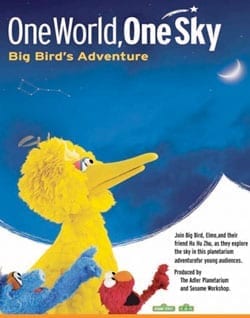
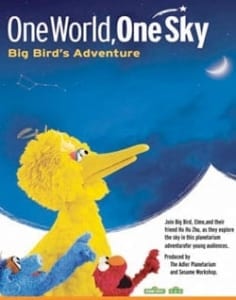
Young audience members will be thrilled when they find themselves on Sesame Street with their famous friends, Big Bird and Elmo. The fun begins when Elmo’s friend, Hu Hu Zhu, visits from China and the three of them take the audience on an exciting journey of discovery to learn about the Sun, stars, and Big Dipper.
Elmo and Hu Hu Zhu blast off on an imaginary trip to the Moon and when they return home to Earth everyone discovers that, no matter where we live, we all share the same sky.
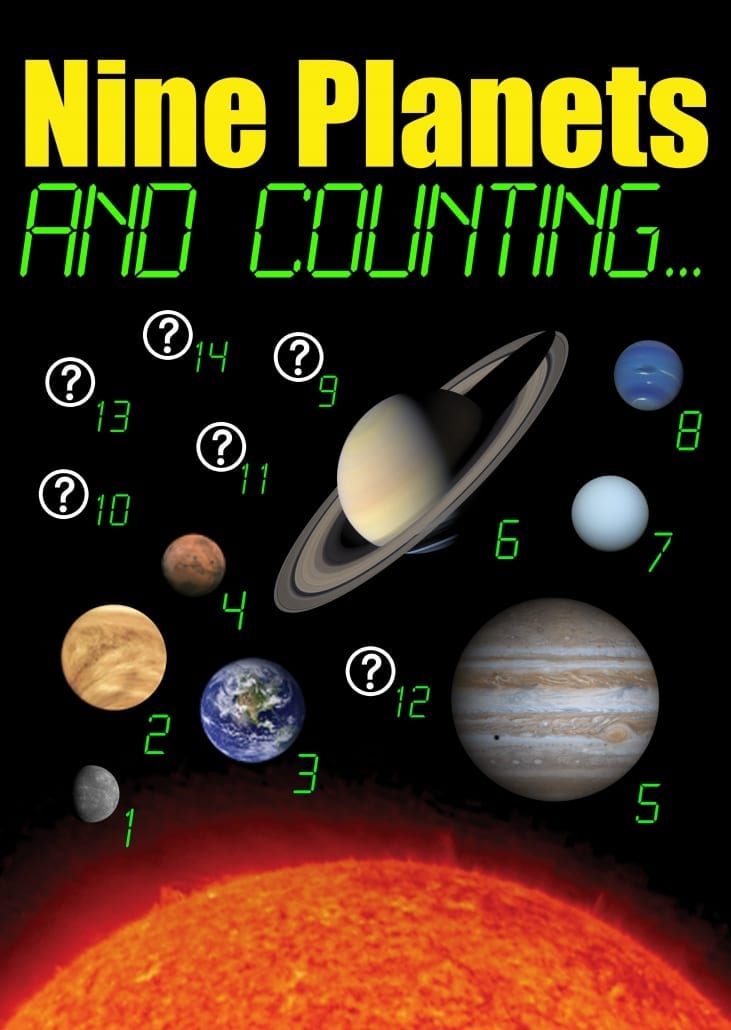
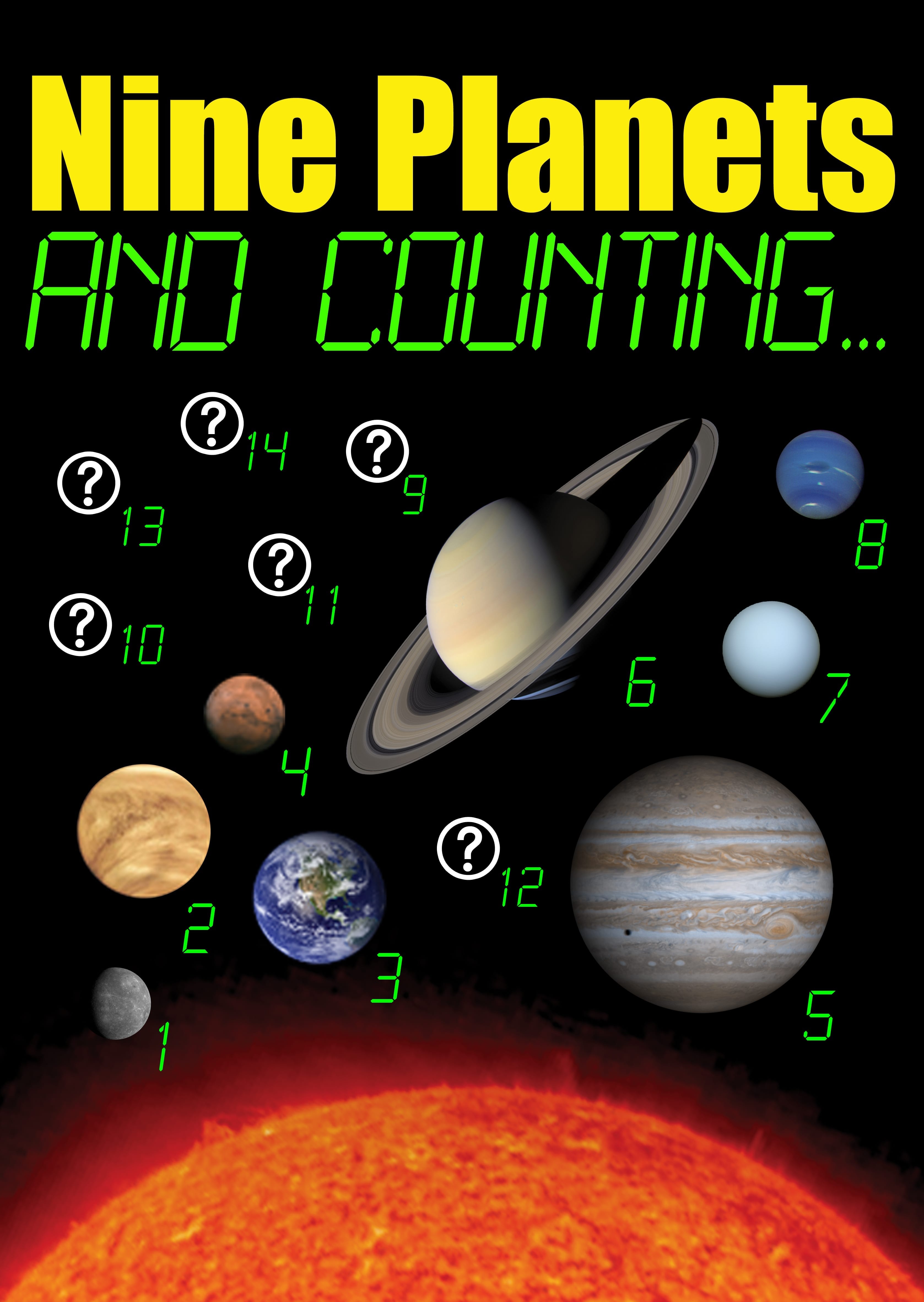
Your audiences want to know, or they wouldn’t keep asking the same question every day!
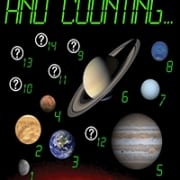
Planets are not just an important part of the curriculum standards. Our neighbors in space fascinate people of all ages. We’ll take a look at every planet in detail, highlighting their similarities and differences.
The program also looks at the big picture, grouping the planets as rocky, gassy and icy worlds, and shows that little Pluto isn’t alone but has hundred or even thousands of companions all beyond the orbit of Neptune. We examine why there’s even a debate over the definition of the word ‘planet’ today.
The show is written to be open-ended about the definition of the word ‘planet’, and serves as an excellent springboard for discussion afterwards. You may find audience members have changed their minds by the end of the show! In the end, it all comes down to what we humans decide to name things.
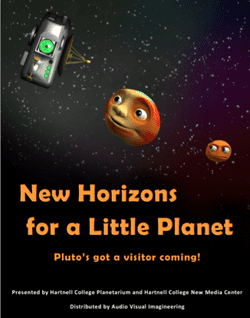
“New Horizons for a Little Planet”, to all full dome planetariums.
“New Horizons for a Little Planet” is a lighthearted introduction to NASA’s New Horizons mission to Pluto and the Kuiper Belt. Launched in 2006, the New Horizons spacecraft is scheduled to fly by Pluto and its moons in July of 2015. The purpose of the program is to introduce planetarium visitors to the mission prior to its arrival at Pluto.
After it encounters Pluto, New Horizons will continue on through the Kuiper Belt and the mission will likely be extended. A smaller, more primitive Kuiper Belt Object will then be targeted for a rendezvous in 2018 or 2019. These encounters promise us unprecedented close up views of these distant worlds and the information gathered by New Horizons will provide valuable insight into the formation of our solar system and its planets.
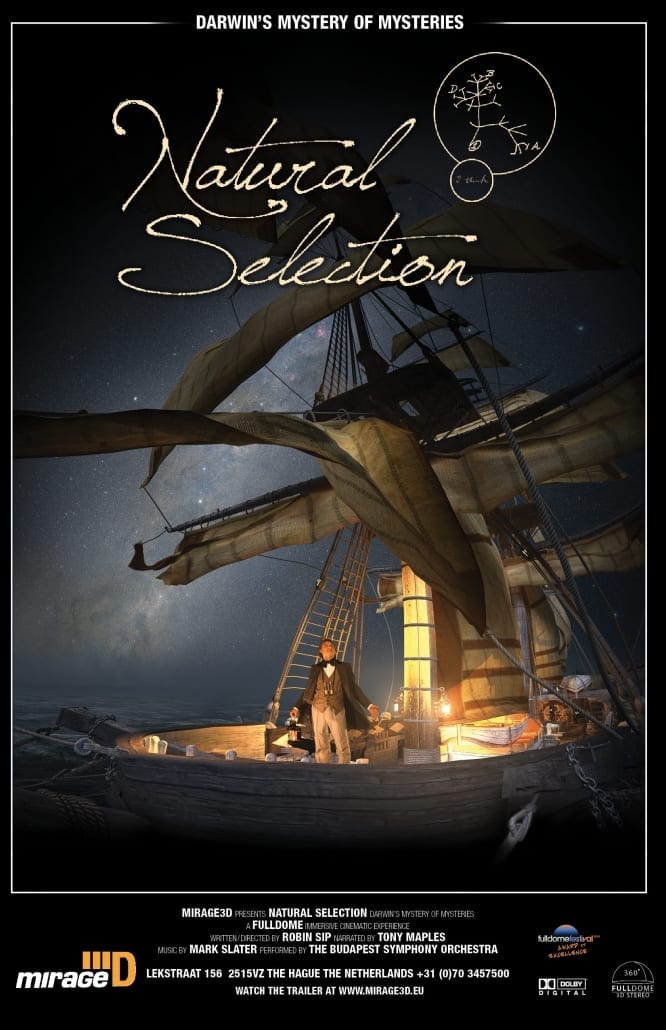
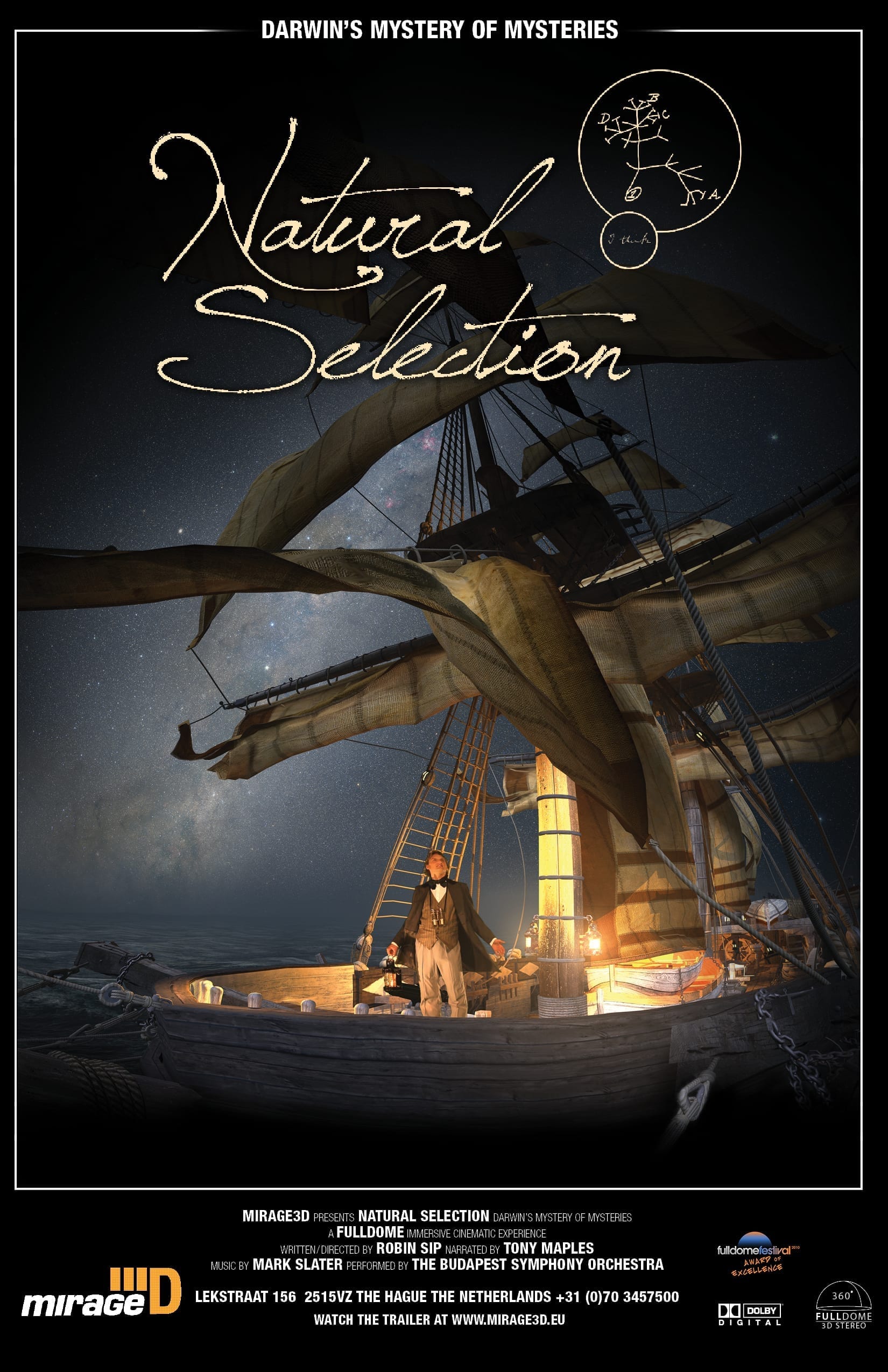
Natural Selection Celebrates the 150th Anniversary
of the Publication of “On the Origin of Species” and the 200th Anniversary of Charles Darwin’s Birth.
We will join Darwin on his voyage with the HMS Beagle to the Galapagos Islands where he was inspired to develop his later theory of transmutation by natural selection.
From the comfort of Down House in Kent, Darwin himself will explain the mechanism of natural selection to the audience, and support it by showing many beautiful examples in nature.
The thrill of a scientific discovery, the adventure of science and the beauty of nature are central in this show.
Keep up to date!
Sudekum Planetarium’s Mars Update lets you provide your audiences with the latest news from Mars.
The show begins with a fifteen-minute, self-contained chapter of how our views on Mars have changed over the years – from H.G. Wells and Percival Lowell to Spirit and Opportunity.
Although this introduction mentions Mars missions up to and including the recent Mars Exploration Rovers, we make no reference to their current status and give only a quick overview of what they have discovered. That’s on purpose – it’s up to you in the second (live) part to bring your audience up to date. The live part can include as much or as little detail as you want: from where to find Mars in the current night sky to the current status of the rovers, what they’ve discovered, and what other spacecraft have been, or will be doing on Mars.
To get you started with this second section, Sudekum Planetarium provides a fully annotated sample script and plenty of slides and video. Feel free to add, subtract, edit and make it your own show.
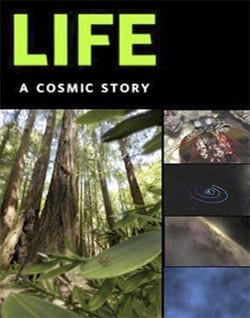
One redwood looms large, until we approach its branches and enter one of its leaves, adjusting our perspective to microscopic scales inside a cell.We see a pared-down version of its inner workings, learning about the process of photosynthesis and the role of DNA.
This scene sets the stage for the story of life.
We then leap backward billions of years to the origin of elements themselves. The early Universe contained mostly dark matter, which drew hydrogen and helium together to form the first stars. The carbon and heavier elements required by living organisms came from generations of stars.
We continue our journey, diving into the Milky Way Galaxy of several billion years ago. We approach a region in which stars are forming, where we encounter a protoplanetary disk surrounding our newborn Sun. We arrive at the young Earth, splashing down in deep water to visit a hydrothermal vent and to examine the formation of organic molecules. We then travel above a volcanic island to encounter an enriched “hot puddle” of water, in which nucleotides may have wrapped themselves in protective vesicles. Once life took hold, it radically changed our planet.
Earth’s early microorganisms created our oxygen atmosphere—and may have also triggered a global ice age, causing temperatures to drop precipitously and nearly freezing out life on our planet. We continue leaping forward in time, viewing the movement of continents and the changing environment for life, until we reach modern Earth.
We return home to look at Earth once more, circling the modern globe to review the evidence for the story we have heard. Much of what we understand about evolution we have pieced together from the fossil record, but we can also reassemble evolutionary history by studying life that surrounds us today. All life shares a common ancestry and common chemistry, all related at the molecular level. As we learn this, we pull away from individual images of life, and we end the show as we see their three-dimensional distribution form the double-helix strand of DNA. The audience is left immersed inside a representation of the structure of life’s shared origins.
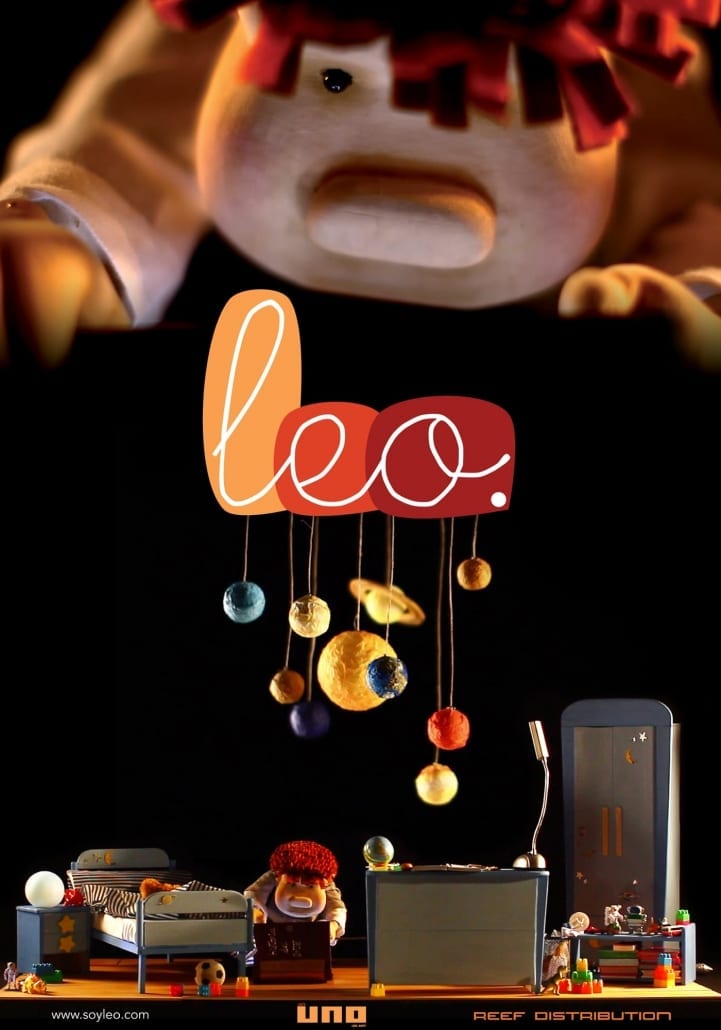
and learn the basics of some of its most significant moments, such as the beginning of what is meant by art, with cave paintings, the genius of Art and Science of Leonardo Da Vinci, and we learn that there is not only one way to see the stars with Van Gogh.
Leo is an educational project about Art and Science, where two techniques are combined, puppets carved in wood and digital animation, with the aim of entertaining children and adults to awake their interest in Art and Science.

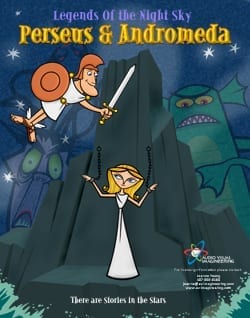
Perseus and Andromeda is 20 minutes of fun, while also teaching children and adults the Greek story about the stars.Planetarians can use Legends as pre-shows to a traditional star ID show and lecture. By engaging the audience with a wonderful story filled with humorous and exciting characters, you are also engaging their desire to learn about astronomy. People love Legends. Planetarians who have seen the laser version say it is educational AND entertaining, for adults as well as children. You can be sure your audiences will love Legends as well!
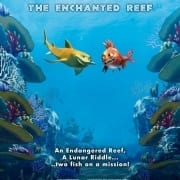
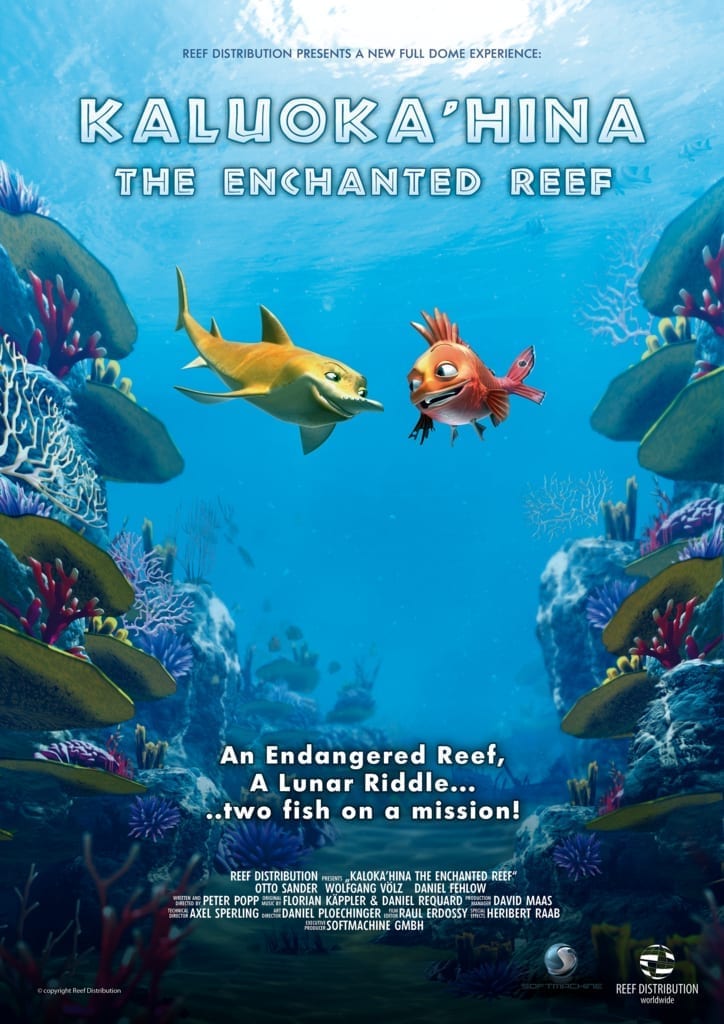
One of its most precious is Kaluoka’hina, the enchanted reef whose magic protects it against humans finding it.
“Kaluoka’hina – The Enchanted Reef” is a pioneer work: it is the first fulldome movie with a plot originally produced for the 360° fulldome projection format. More than 2.5 million people have seen Kaluoka’hina (a fictional name for a coral reef somewhere in the oceans) in more than 150 planetariums or fulldome theaters around the world.
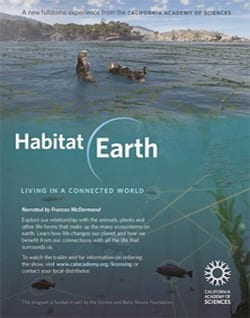
Living Networks Connect and Support Life Forms…
large and small—from colonies of tiny microbes and populations of massive whales to ever-expanding human societies. In the California Academy of Sciences’ latest original planetarium show, Habitat Earth, discover what it means to live in today’s connected world. Through stunning visualizations of the natural world, dive below the ocean’s surface to explore the dynamic relationships found in kelp forest ecosystems, travel beneath the forest floor to see how Earth’s tallest trees rely on tiny fungi to survive, and journey to new heights to witness the intricate intersection between human and ecological networks.